For Assignment 1, I have chosen a picture when I went to the Great Wall of China. The signs in the image included stone stairs, a Chinese pavilion, mountains and tree branches. All these signs create an oriental environment and symbolise the Chinese culture.
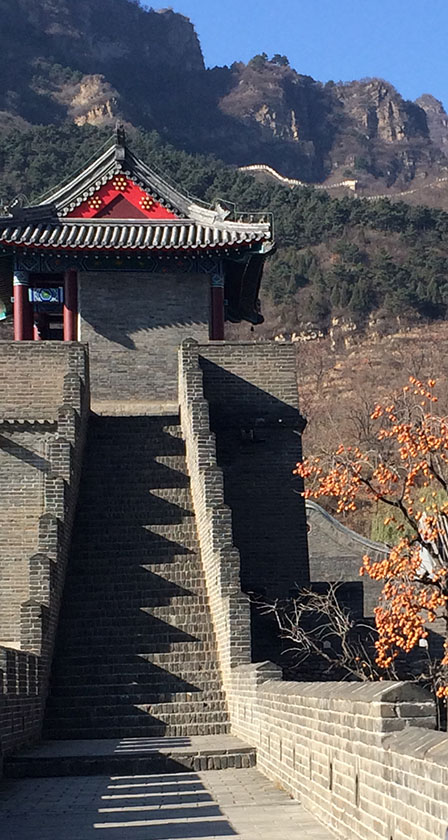
According to the Week 4 Lecture notes (2020), the process of abstraction is one of distillation, the reduction of multiple visual factors to only the essential and most typical features of what is being represented. Therefore, in the process of abstraction, I decided to keep the two important signs: the stone stairs and pavilion, as the main focal point of this assignment.
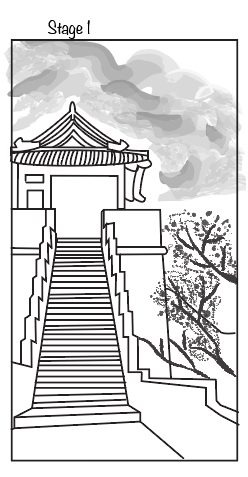
For this assignment, I choose to use illustrator. At stage 1, I use the pen tool to trace out the outlines of the pavilion and stairs. Additionally, I use the paintbrush tool to draw out the mountain and trees. The reason why I did not trace out the mountain and trees as normal lines do not show the texture of the sign. When I think of a mountain, I think of trees and rocks. The brush shows the uneven texture of a mountain, especially in a 2D art-board. At some parts, the brush strokes may be darker, indicating that there are more trees. Lighter brush strokes indicate lesser trees. Similarly, for the trees. I choose to use a dark think brush tool to draw the branches. I also used a brush tool to create the illustration of the yellow leaves.
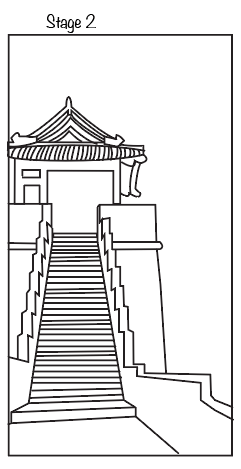
At stage 2, I take out the mountain and trees as these signs are not my focal point. Not many changes were done in this stage.
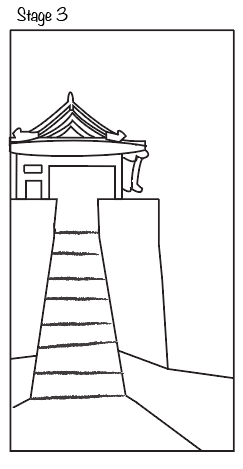
At stage 3, I decided to abstract the stairs by decreasing the number of steps and changing the straight black lines to brush strokes. From stage 2 to stage 3, the main change is that the stairs turn from a 3-dimensional sign to a 2-dimensional sign. The stairs now look ‘flat’ as compared to stage 2. Additionally, I remove extra detailing of the pavilion so that the sign could be abstracted more easily in stage 4.
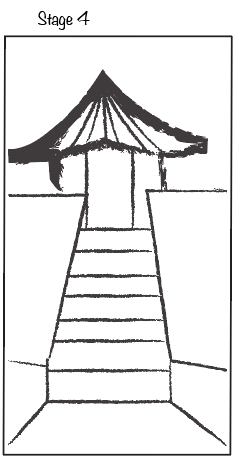
At stage 4, the pavilion sign is furthermore abstracted. I use the paintbrush tool to draw the outline of the pavilion. The pavilion has now turn into a 2-dimensional sign. I have also centred the stairs and pavilion using the rule of thirds. In lecture 5, the Rule of Thirds offers a pleasing and balanced arrangement in both horizontal and vertical orientation. In my case, the signs are centred horizontally since the emphasis is on the pavilion and the stairs.
At stage 5, more abstraction was done. The overall image was created using the paintbrush tool. The details of the pavilion architect were removed, leaving the outlines behind. The stairs were replaced by the oriental cloud, also known as the prosperity cloud. There are two reasons for choosing the cloud. Firstly, the drawing symbolizes Chinse calligraphy. In the process of abstraction, I do not want to the oriental feeling to the image, that is unique and exclusive to the Chinese architect. Chinese calligraphy is an important element in Chinese culture, and it is easy to identify. By replacing with the cloud, the abstraction does not lose its focus and tone. Secondly, the prosperity cloud symbolized the sky, which means that one must go up in order to reach the pavilion. There are many layers within the clouds, which means one must climb the layers in order to reach the pavilion.
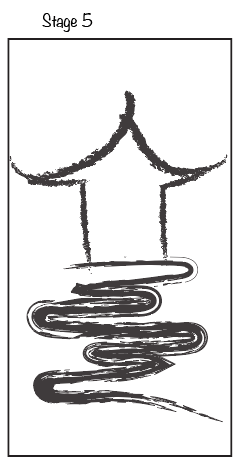
In conclusion, the main focal point is on the pavilion as it is a unique sign to the Chinese culture. However, I do not want to eliminate the stairs element as it is a unique point to the image chosen. The final abstraction wants to convey the traditional Chinese culture to the audiences.

